
VisitPrep is designed to help people understand what matters in routine laboratory results, what to do next, and what to discuss with their clinician. Two small online exploratory studies examined whether adults who recently had difficulty interpreting laboratory results understood the VisitPrep concept, perceived potential value in it, and would choose to purchase a stand-alone report.
#What we studied
#Stage 1 value-proposition study
Twenty U.S. adults age 35 or older were divided evenly between two versions of the VisitPrep positioning. Both groups viewed the same synthetic VisitPrep example.
- Arm A emphasized understanding what matters in laboratory results.
- Arm B emphasized knowing what matters, what to do next, and what to ask the clinician.
The study examined whether the broader visit-preparation promise added perceived value beyond laboratory-results clarity alone.
#Stage 2 economic-choice study
A separate group of 30 U.S. adults age 35 or older viewed the same synthetic example and selected what they would most likely do while waiting several days for clinician review:
- Pay $19 for a VisitPrep report
- Use free Google or AI tools
- Wait for the clinician
#What we found
#Stage 1 results
In Stage 1:
- 18 of 20 participants correctly understood VisitPrep’s intended purpose.
- 19 of 20 rated the example mostly or completely clear.
- 16 of 20 said they would have used VisitPrep when they last had questions about laboratory results.
- 19 of 20 preferred access through a patient portal, clinician or health system, employer, or health plan.
- One participant preferred purchasing an individual report.
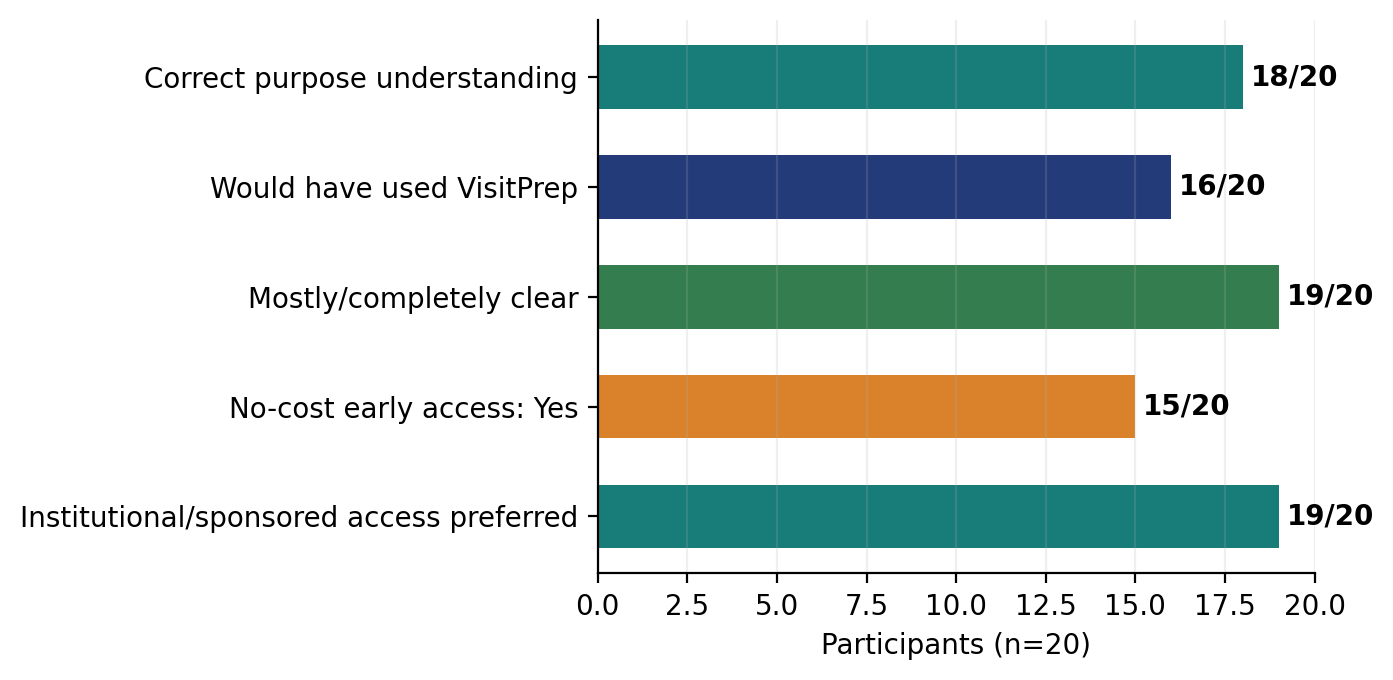
The broader visit-preparation positioning produced directionally higher usefulness, trust, and hypothetical use than laboratory-results clarity alone. Because each arm included only 10 participants, the study cannot establish that one version was statistically superior.
#Stage 2 results
In Stage 2:
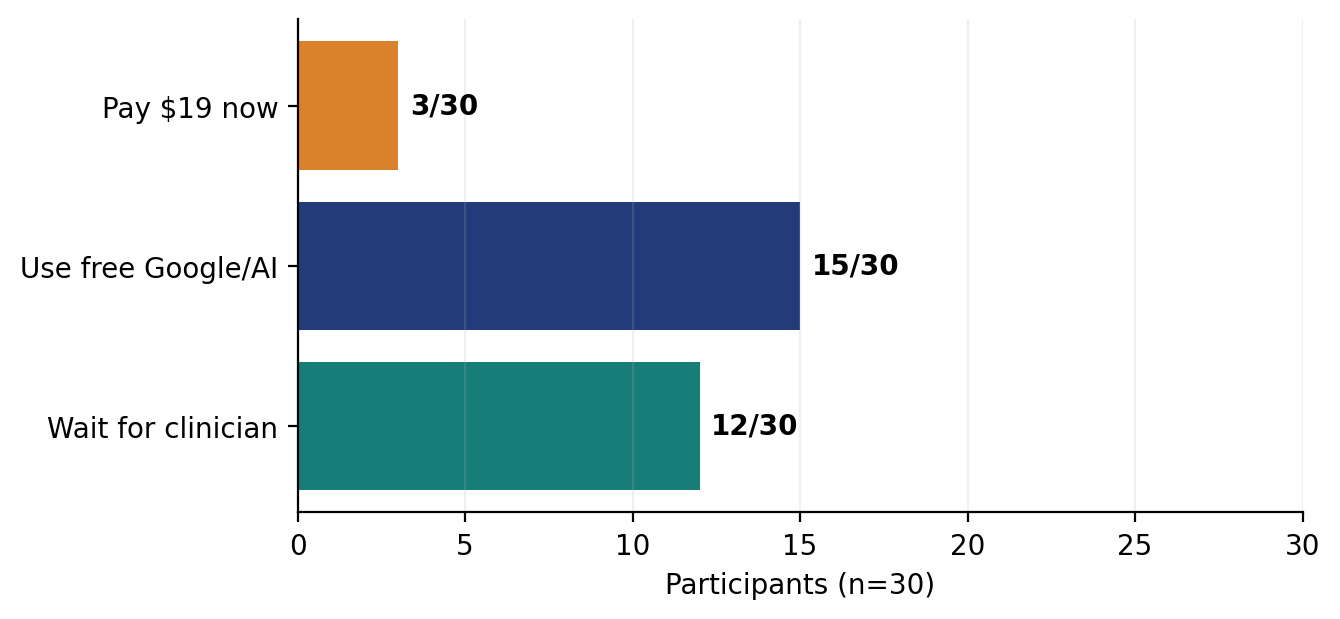
- 3 of 30 participants selected “Pay $19 now.”
- 15 of 30 selected free Google or AI tools.
- 12 of 30 selected waiting for their clinician.
- The median stated maximum price for one report was $5.
- 22 of 30 placed the maximum value of a single report at $5 or less.
- Only one participant reported a price ceiling that accommodated the proposed $19 price.
#What the results suggest
Among adults screened for recent difficulty interpreting laboratory results, participants generally understood VisitPrep and often reported that they would have used it.
The findings also suggest that a stand-alone $19 direct-to-consumer report has limited appeal when free search and AI tools—and waiting for a clinician—are available.
The strongest distribution signal favored access through an existing institution or sponsor rather than individual report purchases. These early findings support further evaluation of portal-based, clinician-sponsored, health-system, employer, or health-plan distribution.
Consumer preference for these channels does not establish that an institution is willing to purchase, sponsor, or implement VisitPrep.
#What these studies do not establish
These exploratory studies do not establish:
- Clinical accuracy, safety, or diagnostic performance
- Improved health outcomes
- Reduced anxiety
- Fewer portal messages
- Shorter clinical appointments
- Better adherence
- Lower healthcare costs
- Actual purchasing behavior
- Population-wide consumer demand
- Institutional willingness to pay
- Operational feasibility within a practice, laboratory, portal, or health system
- Superiority to clinicians, patient portals, Google, or AI
#Recommended next evidence step
The next research question is whether VisitPrep can improve patient preparation without increasing clinician workload, privacy exposure, or liability.
HealthRadar plans to explore this question through interviews with primary-care decision-makers and a small practice-based feasibility pilot rather than another general-consumer preference survey.
#Methods and disclosure
Both studies were conducted through Lyssna in September 2026 using compensated online research-panel participants. Eligible participants reported recent routine blood testing and difficulty understanding their results or deciding what to do next. Healthcare professionals who interpret laboratory results were excluded.
Each participant viewed fictional laboratory data. No personal health information was requested. All purchasing and access choices were hypothetical, and no payment or deposit was collected.
The studies were designed and funded by the HealthRadar founders. Results are descriptive and exploratory. VisitPrep is a prototype and is educational; it is not a diagnosis or substitute for medical care.